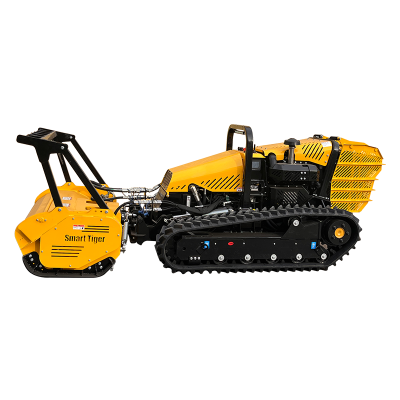
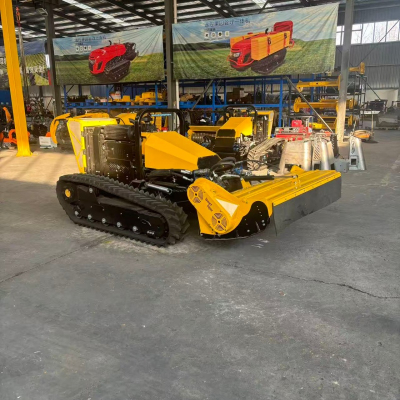
Analysis of Selection Strategy and Technical Advantages of Specialized Remote-Controlled Mowers for Forestland, Photovoltaic Areas, and Shrublands
Mechanization Challenges in New Energy and Ecological Management Scenarios
With the rapid global expansion of green energy infrastructure and the deepening of refined forestry management, three specialized scenarios—forest land tending, vegetation control in photovoltaic power stations, and shrubland clearing—are placing unprecedented technical demands on professional mowing equipment. Traditional manual labor or general-purpose machinery can no longer meet the integrated requirements of safety, efficiency, and ecological compatibility. This article delves into the distinct characteristics of these three scenarios and systematically elaborates on the core advantages and technical selection logic of remote-controlled intelligent mowers, providing industry users with a scientific framework for equipment selection.
Operational Characteristics and Core Challenges of the Three Application Scenarios
1. Forest Land Tending Operations
Scenario Characteristics: Undulating terrain, narrow spacing between trees, numerous roots and fallen logs on the ground, and the need to protect young trees and soil structure.
Core Challenges:
Equipment must feature a narrow body design (≤1.5 meters) and high maneuverability.
Operations must avoid damaging tree roots and the surface humus layer.
Slope operations require strong anti-rollover capability.
2. Vegetation Control in Photovoltaic Power Stations
Scenario Characteristics: Large-scale panel arrays, limited ground clearance for components (typically 0.5–1.2 meters), extensive cable trenches, and the need to prevent dust and component damage.
Core Challenges:
Equipment must have an ultra-low-profile design (height ≤0.8 meters) to operate beneath panels.
Requires precise obstacle avoidance and flexible cutting to prevent collisions with supports and cables.
Dust generation must be controlled to avoid impacting the power generation efficiency of photovoltaic panels.
3. Shrubland and Wild Grassland Clearing
Scenario Characteristics: High vegetation density, inclusion of shrubs and tough weeds, hidden terrain features, and potential debris.
Core Challenges:
Requires a high-strength cutting system (e.g., tungsten steel flail head) to handle shrubs 3–10 cm in diameter.
Equipment must possess strong self-extrication capabilities and undercarriage protection.
Remote control operation is essential to protect personnel from flying debris risks.
Key Technology Selection System for Specialized Remote-Controlled Mowers

1. Power and Transmission System Configuration Strategies
Forest Land Scenario:
Recommended power: 25–35 kW diesel engine (e.g., Yanmar 3TNV88T), balancing power and fuel efficiency.
Transmission method: Fully hydraulic four-wheel drive system with anti-entanglement undercarriage guards.
Photovoltaic Scenario:
Recommended power: 15–20 kW low-noise electric or hybrid system to reduce dust and exhaust emissions.
Transmission method: Independently motor-driven tracks for zero-radius turning.
Shrubland Scenario:
Recommended power: 30–40 kW high-torque diesel engine (e.g., Kubota V3800) to handle high-load impacts.
Transmission method: Reinforced hydraulic motor + planetary gear reducer combination.
2. Differentiated Adaptation of Cutting Systems
Forest Land Tending | Narrow-arm flail head (1.2 meters) | Contour floating design, avoids tree trunks, mulch particle size ≤5 cm | 3–5 mu/hour |
Photovoltaic Areas | Low-profile rotary blade set (0.6–1 meter) | Equipped with elastic protective cover and dust-control water spray interface | 8–12 mu/hour |
Shrubland Clearing | Heavy-duty hammer-type mulching head | Three-direction hydraulic obstacle avoidance, mulching capacity up to 10 cm diameter | 2–4 mu/hour |
3. Scenario-Specific Design of Travel Systems
Forest Land/Shrubland Scenarios:
Utilize wide rubber tracks (width ≥400 mm, ground pressure ≤25 kPa) equipped with central balancing beam suspension, suitable for slopes up to 40°.
Photovoltaic Scenarios:
Use polyurethane-coated tracks (width 300 mm) with a no-trace design, ground pressure ≤18 kPa, to protect cable trenches and drainage facilities.
Six Core Advantages of Remote-Controlled Intelligent Mowers
1. Safety Revolution: Complete Human-Machine Separation
150-meter ultra-long-distance remote control for cross-slope/zone operations.
Automatic speed reduction at inclinations ≥50°, emergency braking at ≥55°.
Equipped with dual-mode infrared and millimeter-wave obstacle avoidance, response time <0.1 seconds.
2. Efficiency Leap: Intelligent Operation Management System
Supports Beidou/GPS dual-mode path planning, with repetitive positioning accuracy of ±5 cm.
Memory operation function improves efficiency by 300% for the same paths in photovoltaic areas.
Automatically generates operational reports (area, fuel consumption, anomaly points).
3. Eco-Friendliness: Refined Operational Modes
Forest land mode: Adjustable cutting height (5–20 cm) to preserve the surface microbial layer.
Photovoltaic mode: Dust control system reduces PM2.5 emissions by 85%.
Shrubland mode: Mulch cover technology reduces soil erosion by 70%.
4. Engineering Breakthrough in All-Terrain Adaptability
Wading capability up to 500 mm, suitable for wetland photovoltaic areas.
Climbing performance: 45° (forest land version)/35° (photovoltaic version).
Operational temperature range: -20°C to 55°C.
Choosing a professional remote-controlled mower is not merely an equipment upgrade but a systemic transformation of operational philosophy. In the three major scenarios of forest land, photovoltaic areas, and shrublands, it is redefining:
Safety Boundaries: From "shared risk" to "absolute isolation."
Efficiency Logic: From "labor accumulation" to "intelligent output."
Ecological Relationships: From "intervention management" to "collaborative symbiosis."