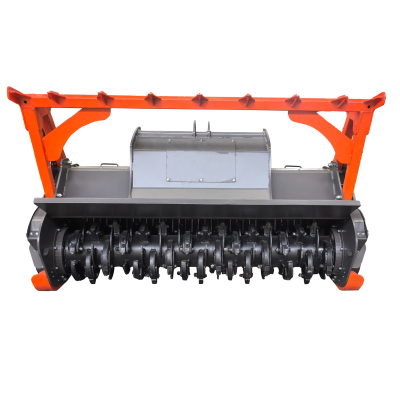
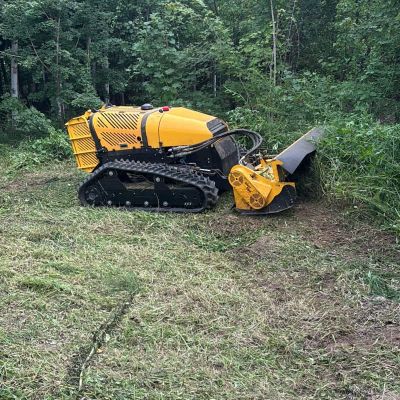
Remote Control Mower Buying Guide: Single Hydraulic Interface for Flail Head and Mulcher Head
How to Choose a Remote Control Mower: A Seven-Point Buyer's Guide for Slope and Land-Clearing Work
Choosing a remote control mower is no longer a niche decision. As steep-slope vegetation work shifts from crews with brush cutters to tracked machines controlled from a safe distance, buyers face a crowded market — and not every remote control mower on offer is built for commercial duty. This guide explains how to choose a remote control mower for slope maintenance, land clearing and municipal contracts, setting out the seven criteria that separate a working asset from an expensive experiment.
Why Demand for the Remote Control Mower Is Rising
Market data explains the momentum. According to Emergen Research, the global remote lawn mower market was valued at USD 2.86 billion in 2025 and is projected to reach USD 9.20 billion by 2035, a compound annual growth rate of 12.4%. Global Market Insights estimates the oscillating, rotary and flail mowers segment at roughly USD 6.2 billion in 2025, growing toward USD 9.3 billion by 2035. Industry research cited by Accio reports that more than 65% of new commercial-grade steep-slope mowers now feature remote or semi-autonomous operation.
Behind the numbers sit practical pressures: labour shortages, tighter safety enforcement — a U.S. OSHA review recorded 35 lawn-mower rollover fatalities since 2019 — and expanding maintenance obligations on roads, levees, solar farms and firebreaks. Every one of these pressures points buyers toward a tracked remote control mower rather than a ride-on unit, which is why the buying question has changed from "do we need one?" to "how do we choose the right one?"
The Seven Criteria That Decide the Right Remote Control Mower
1. Slope Capability and Stability
Before you choose a remote control mower, ask how steep your steepest site is. A machine rated at 30 degrees cannot work a 45-degree embankment, and derating a machine to "just get by" is how rollovers happen. Look for a remote control mower rated to at least 45–55 degrees in any direction, with an inclinometer-based alarm around 50 degrees and automatic shut-off at the limit. Confirm the rating covers lateral, side-slope work — not only climbing straight up — because most embankment passes are made across the face.
2. Engine, Emissions and Fuel Autonomy
When you choose a remote control mower, ask what engine is fitted, who makes it, and which emission standard it meets. EU buyers need Stage V; North American buyers need an EPA-certified engine configuration. A YANMAR three-cylinder water-cooled diesel rated 28.2 kW (38.3 Hp) at 2600 rpm with a 28-litre tank, as fitted to the Smartiger remote control mower, delivers a realistic full-shift run time on slope work. Emission compliance is not paperwork: it decides whether your machine can be deployed on public tenders and in low-emission zones.
3. Hydraulic Architecture and Component Quality
A tracked remote control mower lives or dies by its hydraulics. Look for independent circuits — one for the cutting head, one for track drive, one for auxiliary motions — so the head keeps rotor speed when the machine climbs. Check pump and motor brands: Bondioli & Pavesi pumps, Poclain high-torque drive motors and Danfoss high-speed motors are the benchmark components in this class. Confirm the attachment circuit delivers the flow and pressure the head needs; 84 L/min at 250 bar is the working point of the Smartiger flail head.
4. Track Design and Traction
On a remote control mower, rubber tracks with heightened teeth are the standard for steep ground: they spread weight, hold on wet grass and protect turf on landscaped sites. Compare track width, tooth pattern and ground pressure, and ask whether skid steering supports pivot turns, because tight corners on embankments and orchard rows demand it. A remote control mower with weak traction becomes a slope hazard regardless of its engine.
5. Remote Control Range, Redundancy and Safety Shut-Offs
How far can the operator stand from your remote control mower? For roadside and embankment work, a 150-metre range on 2.4 GHz keeps the operator outside the debris zone and lets one person cover a long face. Then ask about failure behaviour: your remote control mower must shut off automatically on signal loss, on abnormal hydraulic oil or lubrication pressure, and at the over-slope limit. Interchangeable rechargeable batteries — two per unit, chargeable on the machine — decide whether the machine keeps working through a shift.
6. Attachment Ecosystem
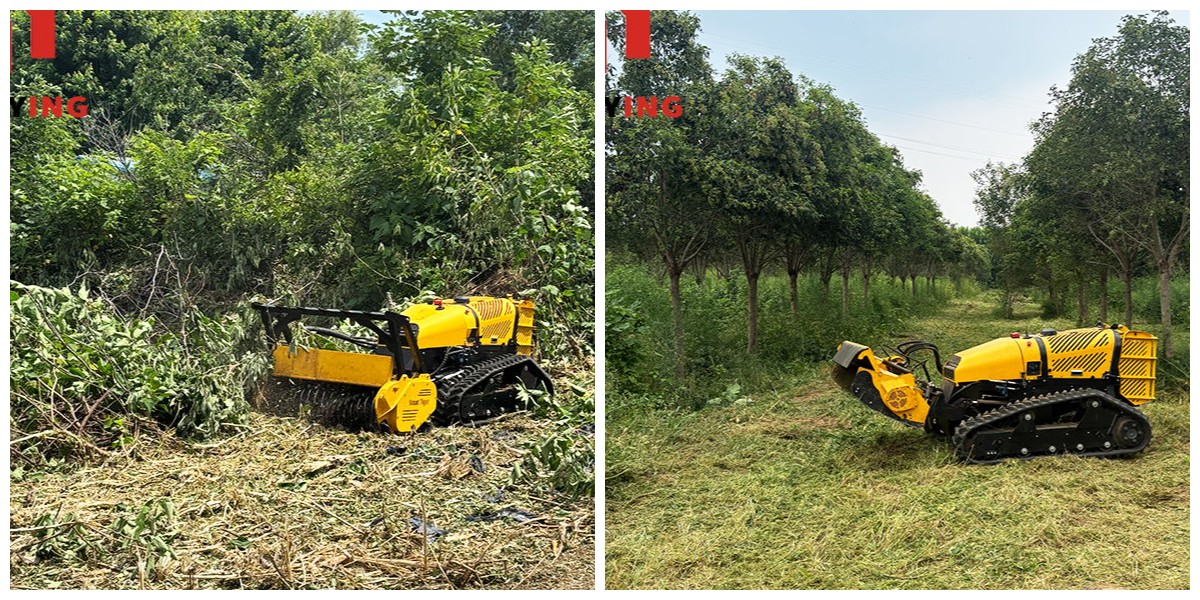
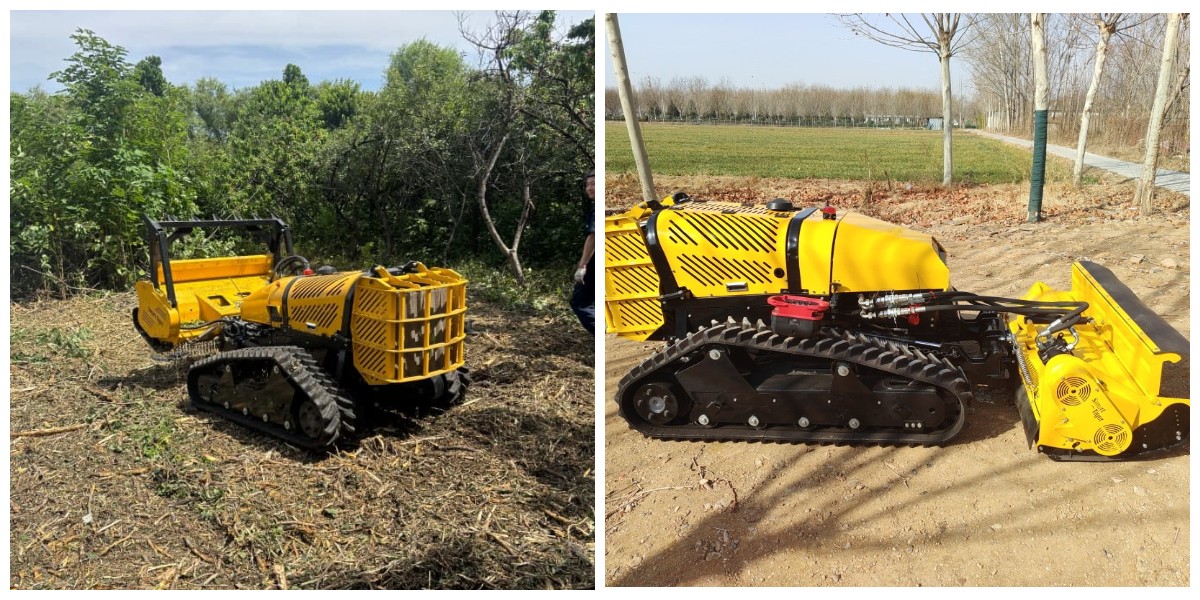
When you choose a remote control mower for land clearing, one chassis should cover three tasks. A standard flail head — 1,400 mm rotor, Y-flails for grass and light wood up to 50 mm, hydraulic lift from −200 to +500 mm, auto-float ±10 degrees — handles verges and embankments; a mulcher head of 1,200 mm takes scrub up to 150 mm; a branch crusher takes wood up to 100 mm. Confirm the host allocates hydraulic flow intelligently and that head changes take minutes, not hours.
7. Manufacturer, Support and Export Capability
Buy from a manufacturer, not a trader. Ask who builds the machine, what pre-shipment testing is performed, which spare parts are stocked, and whether the supplier can support your market with documentation, training and export logistics. A remote control mower is a 1,250-kilogram capital asset; the difference between a factory partner and a middleman shows up in year three, not week one.
How the Smartiger Remote Control Mower Measures Up
Against these criteria, the Smartiger remote control mower — built by Qingdao Huaying Intelligent Equipment Co., Ltd., a subsidiary of Shandong Hongchuan Machinery Manufacturing Co., Ltd. — reads as a commercial-grade answer: 55-degree slope capability with an alarm at 50 degrees and shut-off at 55 degrees; a Euro 5 YANMAR diesel; independent Bondioli & Pavesi, Poclain and Danfoss hydraulic circuits; heightened-teeth rubber tracks; a 2.4 GHz remote with a 150-metre range and two hot-swap batteries; and three working heads on one chassis. At 1,250 kg with a 380 kg flail head, it is sized for contractor trailers and municipal depots.
From Factory to Jobsite: How the Machine Is Built and Used
In production, the platform is assembled around the engine and hydraulic package, with each circuit pressure-tested before the cutting head is fitted; every remote control mower then runs a loaded test cycle and a pre-shipment inspection before export packing. On site, the workflow stays deliberately simple: one operator unloads the remote control mower, walks the slope to plan the pass, and works from up to 150 metres away — flail head for grass, mulcher for scrub, crusher for branches — while the auto-float roller holds a consistent cut height across undulating ground.
Frequently Asked Questions
What slope can a commercial remote control mower handle?
Commercial remote control mowers typically work 45–55 degrees. The Smartiger remote control mower is rated to 55 degrees in any direction, sounds an alarm at 50 degrees and shuts off automatically at 55 degrees.
Should I specify a Stage V or an EPA-certified engine?
It depends on your market. EU buyers need Stage V; U.S. buyers need an EPA-certified configuration. Ask the manufacturer of your remote control mower for the certificate covering the exact power rating and market — never accept "generally compliant" as an answer.
Tracked or wheeled — which should I buy?
Tracked. On slopes above 40 degrees and on soft ground, wheels lose traction; crawler tracks are precisely why a remote control mower can work where ride-on units cannot follow.
Which attachments should a land-clearing buyer order?
Start with the flail head, add the mulcher for scrub up to 150 mm, Optional flail head for weeds and small shrubs up to 5 cm. Both attachments share one hydraulic interface, enabling one base machine for multiple working conditions.
Choose With Confidence — Talk to the Factory
If you are comparing remote control mowers for a fleet, a tender or a dealership line, use the seven criteria above as your checklist, then ask us to match a configuration to your terrain, vegetation and budget. Our export team can provide full specifications, emission documentation, attachment options, FOB or CIF pricing and delivery schedules for your market. Contact us today for a quotation and a demonstration video of the Smartiger remote control mower working a 55-degree slope.