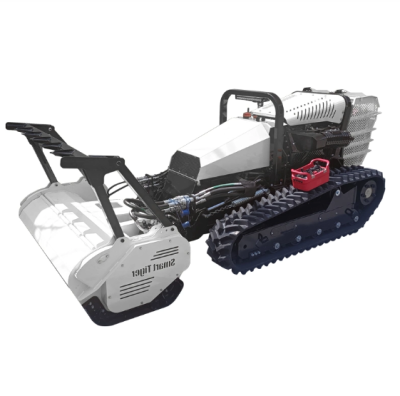
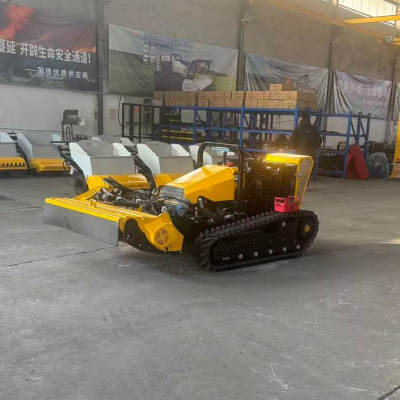
Remote-Controlled Mowers vs. Traditional Mowers: Why Professional Maintenance Teams Are Switching to Huaying Intelligent Equipment
For landscaping contractors, municipal maintenance crews, and vegetation management professionals, few decisions carry as much weight as equipment selection. The choice between traditional walk-behind or ride-on mowers and remote-controlled tracked alternatives can mean the difference between profitable, safe operations and costly, hazardous workarounds—particularly when the job involves steep slopes, roadside embankments, drainage ditches, or other challenging terrain.
This comparison examines four critical dimensions—safety, efficiency, terrain adaptability, and long-term operational value—to help procurement decision-makers understand why an increasing number of professional teams are turning to Huaying Intelligent Equipment's remote-controlled mowers.
Part One: Safety—The Non-Negotiable Difference
The Reality of Traditional Mower Operations on Slopes
Operating conventional mowers on steep terrain carries inherent risks that no amount of operator training can fully eliminate. The statistics are sobering. According to the U.S. Consumer Product Safety Commission, approximately 70,000 people are treated in hospital emergency rooms for mower-related injuries each year, with about 90 deaths occurring annually—most commonly when riding mowers overturn and crush operators.
In 2007 alone, there were 61 deaths and 15,000 reported injuries on zero-turn mowers specifically. The most common scenario? The mower overturning and the operator being crushed beneath it.
These are not isolated incidents. In August 2024, OSHA reported a fatal incident where a zero-turn mower overturned in a residential front yard. The employee sustained fatal crushing injuries to the head and upper body because the mower's Rollover Protection System (ROPS) was not installed in the vertical position. The employee was mowing a slope ranging from 16 to 26 degrees—yet the manufacturer had specified that the mower should not be used on slopes greater than 15 degrees.
Most commercial zero-turn mowers are tested on inclines of approximately 20 degrees. Industry guidance from the Occupational Safety & Health Administration (OSHA) specifies that zero-turn and riding mowers are approved only for slopes up to 15 degrees. Beyond that threshold, operators are advised to use string trimmers, push mowers, or specialized equipment. Yet in practice, crews are frequently expected to mow slopes exceeding these limits—often with predictable consequences.
The risks multiply near water. Mowing within five feet of a drop-off, pond, or creek creates conditions where a single slip can send both operator and machine into the water, with often fatal outcomes.
The Remote-Controlled Alternative: Safety by Design
Huaying Intelligent Equipment's remote-controlled mowers fundamentally reimagine slope safety by removing the operator from the hazard zone entirely. With the HUAYEE MHY55 model, operators can control the machine from up to 200 meters away, maintaining a stable, safe position on level ground while the mower tackles the slope.
This distance is not merely a convenience—it is a life-saving feature. By eliminating the need for an operator to physically ride or walk behind the machine on unstable terrain, remote-controlled mowers eliminate the primary causes of mowing fatalities: rollovers, slips, and falls.
Traditional mowers often require operators to make turns on slopes—the moment of highest risk for loss of traction, tipping, or rollover. Remote-controlled tracked mowers, by contrast, are engineered with bidirectional mowing capabilities that eliminate turning maneuvers entirely on long slopes, removing the most critical safety risk from the operation.
The HUAYEE MHY55 incorporates additional safety features including a hybrid drive system that separates cutting power from travel power, electric start for quick engine ignition, and cruise control for consistent speed management during extended mowing sessions. For slopes exceeding 30 degrees, the manufacturer recommends ascending with the rear of the machine facing uphill for optimal stability and safety—an operational flexibility simply not available with traditional mowers.
Part Two: Efficiency—Standardizing Quality, Reducing Labor
The Inefficiencies of Traditional Slope Mowing
Traditional mowing on slopes is not just dangerous—it is demonstrably inefficient. The quality of work depends heavily on the individual operator's experience, skill, and physical endurance. A crew member navigating a steep slope with a walk-behind mower must constantly adjust speed, angle, and cutting height while maintaining personal balance on uneven ground. The result is often inconsistent: some areas overgrown, others scalped.
The labor intensity is staggering. A specialty job that once required six crew members with string trimmers can now be accomplished with a single operator and one remote-controlled mower. This represents a fundamental shift in labor economics—not merely a marginal improvement.
Traditional mowers also struggle with accessibility. Steep slopes often contain areas that are simply inaccessible or difficult to reach with conventional equipment, leading to incomplete lawn maintenance and the need for follow-up trimming by hand. Each additional pass, each manual trimmer session, each safety pause adds to the total job time—and eats into profit margins.
Remote-Controlled Efficiency: Standardized, Repeatable, Reliable
Remote-controlled mowers deliver efficiency gains through standardization. The operator controls the machine from a stable position with a clear vantage point, enabling precise, consistent cutting patterns regardless of the terrain beneath the mower. The machine does not get tired, does not lose focus, and does not require breaks.
Research supports these efficiency claims. A study on remote-controlled mowers for steep slopes found that the prototype achieved work efficiency 2.6 times that of a walking-type mower. In flat fields with clusters of tall vegetation, the remote-controlled prototype was twice as efficient as a brush cutter.
Area performance metrics for modern remote-controlled tracked mowers can reach up to 4,500 square meters per hour through continuous operation—not by traveling faster, but by eliminating the inefficiencies of turning, repositioning, and operator fatigue that plague traditional methods.
The elimination of turning maneuvers on long slopes alone can deliver up to 30 percent time savings. For maintenance teams managing large portfolios of slope sites, these percentage gains translate into real dollars: fewer labor hours per job, more jobs per day, and the ability to bid on work that competitors cannot perform efficiently.
Part Three: Terrain Adaptability—Where Traditional Mowers Stop, Tracked Mowers Begin
The Limitations of Wheeled Mowers on Challenging Ground
Traditional mowers rely on wheels for mobility. On flat, well-maintained turf, this is perfectly adequate. But on slopes, soft ground, uneven terrain, and surfaces with obstacles, wheels become a liability.
Wheeled mowers lose traction on slopes, particularly when grass is wet or the ground is soft. They struggle to maintain stability on uneven surfaces, increasing the risk of tipping. They cannot effectively navigate soft ground without sinking or rutting the soil. And they are often unable to clear obstacles such as roots, rocks, or drainage channels without manual intervention.
On slopes exceeding 15 to 20 degrees, traditional wheeled mowers are operating beyond their design limits. The operator is forced to choose between completing the job unsafely or resorting to slower, more labor-intensive methods such as string trimmers.
Tracked Chassis: Engineered for Extreme Terrain
Huaying's remote-controlled mowers feature tracked undercarriages specifically engineered for stability and traction on challenging terrain. The engineering-grade rubber tracks provide a ground contact area that exceeds that of traditional wheeled mowers by over three times, delivering significantly enhanced traction and preventing slippage.
The tracked design offers several critical advantages:
Superior Traction on Slopes: Tracked mowers maintain grip where wheeled mowers slip. The HUAYEE MHY55 can tackle slopes up to 45 degrees—a figure that far exceeds what conventional ride-on mowers can achieve. For comparison, most traditional zero-turn mowers are tested on only 20-degree inclines.
Low Ground Pressure: Tracked systems distribute the machine's weight over a larger surface area, reducing ground pressure and preventing soil compaction and rutting. This is particularly important on embankments, dykes, and water edges where soil stability is a concern. The AS 990 Tahr RC, which employs a similar tracked design philosophy, achieves ground pressure of just 0.13 kg/cm²—light enough to protect sensitive soil structures while maintaining stability.
Obstacle Clearance: Tracked mowers can navigate over roots, rocks, and uneven ground that would stop a wheeled mower in its tracks. This capability is essential for solar farms, where mowers must operate between panel rows and navigate uneven terrain beneath installations.
Bidirectional Operation: Unlike wheeled mowers that must turn at the end of each pass—a high-risk maneuver on slopes—tracked remote-controlled mowers can mow in both directions without turning, maintaining consistent cutting quality while eliminating the most dangerous moment of slope operation.
Real-World Applications
Huaying's remote-controlled tracked mowers are deployed across a range of demanding environments where traditional equipment cannot operate effectively:
Municipal Roadside Slopes: Highway embankments and road shoulders that are hazardous for manual crews can be maintained safely and efficiently from a distance. The compact tracked platform allows operators to maintain these areas while keeping a safe distance from the slope and traffic.
Solar Farms and Energy Sites: Solar installations often feature sloped terrain and restricted access between panel rows. The low profile and remote operation of tracked mowers allow them to mow beneath solar panels and navigate tight spaces where traditional equipment cannot fit.
Water Conservancy and Embankments: Dams, levees, and drainage ditches—areas where operator safety is a paramount concern—can be managed without putting personnel on dangerous slopes. The tracked design provides stability on the soft, often saturated ground found near water bodies.
Utility Corridors: Power line rights-of-way and pipeline corridors require recurring vegetation maintenance across challenging terrain. Remote-controlled tracked mowers enable crews to maintain these critical infrastructure corridors without exposing operators to the hazards of remote, uneven ground.
Part Four: Long-Term Value—Beyond the Initial Investment
The Hidden Costs of Traditional Slope Mowing
When evaluating equipment purchases, procurement decision-makers often focus on upfront costs. But the true cost of traditional mowing on slopes extends far beyond the purchase price.
Labor Costs: Slope mowing with traditional equipment is labor-intensive. As noted earlier, jobs that require six crew members with string trimmers can be accomplished with one operator and a remote-controlled mower. Over the course of a season, the labor savings are substantial.
Injury Costs: Worker compensation claims, lost productivity, and the human cost of injuries add significant financial and operational burden. Each mower-related fatality or serious injury represents not just a human tragedy but also a major financial liability.
Re-work and Quality Issues: Inconsistent cuts on slopes often require additional passes or manual trimming, adding to total job time and reducing profitability.
Equipment Damage: Traditional mowers operating on slopes are subject to increased wear on engines, transmissions, and cutting decks. The strain of operating beyond design limits accelerates maintenance needs and shortens equipment lifespan.
The Value Proposition of Remote-Controlled Mowers
Remote-controlled tracked mowers from Huaying Intelligent Equipment offer a compelling long-term value proposition that goes beyond simple equipment replacement:
Labor Optimization: With remote-controlled operation, a single trained operator can accomplish what previously required a crew. This is particularly valuable in an industry plagued by labor shortages. Remote-operated and autonomous mowers allow businesses to continue the work they have and take on new work with their existing workforce.
New Revenue Streams: Remote-controlled mowers designed for steep conditions and rough terrain allow businesses to bid and win specialty niche work—the jobs that competitors cannot or will not perform. This creates high-value niche revenue opportunities that are protected from commoditized competition.
Reduced Turnover and Improved Recruiting: Operating advanced, technology-driven equipment is engaging and rewarding for employees. Being ahead of the curve in technology and industry thinking makes a company more desirable for high-value workers, and once on staff, retention improves.
Predictable Operating Costs: Remote-controlled mowers are engineered with serviceability in mind. Service access points, minimal electronic dependency, and robust mechanical systems support predictable operating costs across the machine's lifecycle.
ROI and Payback Period: Remote-operated robotic mowers are built for extreme terrain and offer a much higher ROI compared to traditional commercial equipment. Reduced labor requirements, improved safety, and lower maintenance risks contribute directly to better return on investment. For contractors and service providers, the ability to complete complex mowing tasks faster and safer translates directly into higher productivity and customer satisfaction.
Huaying's products are designed for commercial durability with CE certification and ODM/OEM customization available. The company's strategic positioning in the machinery industry ensures that businesses receive reliable solutions that address the unique demands of professional vegetation management.
Conclusion: Making the Informed Decision
For maintenance team leaders and procurement decision-makers evaluating equipment for steep slope and challenging terrain operations, the choice between traditional and remote-controlled mowers is not merely a technical decision—it is a strategic one.
Traditional mowers offer familiarity and lower upfront costs. But they come with significant trade-offs: operator safety risks that can lead to serious injury or death; labor inefficiencies that erode profit margins; terrain limitations that leave work undone or force manual alternatives; and long-term costs that extend far beyond the purchase price.
Remote-controlled tracked mowers from Huaying Intelligent Equipment offer a fundamentally different value proposition: safety by design, efficiency through standardization, terrain adaptability that opens new work opportunities, and long-term value that delivers measurable ROI.
The HUAYEE MHY55 with its 45-degree slope capability, 200-meter remote control range, hybrid drive system, and engineering-grade rubber tracks represents the new standard for professional slope mowing.
In an industry where safety, efficiency, and profitability are paramount, the question is no longer whether to upgrade—but how quickly. Remote-controlled mowers from Huaying Intelligent Equipment enable professional teams to conquer steep slopes with confidence, maintain consistent quality across challenging terrain, and build a more profitable, sustainable operation.
For product specifications, operation videos, and project-based consultation, contact Huaying Intelligent Equipment with details about your application—whether it involves roadside slopes, solar farms, drainage ditches, embankments, waterways, or utility corridor maintenance.