Remote-Controlled Tracked Mowers vs. Traditional Mowers
Remote-Controlled Tracked Mowers vs. Traditional Mowers: Safety, Efficiency and Long-Term Operational Value
For professional vegetation management teams, municipal maintenance crews and landscaping contractors, equipment selection is a core strategic decision that defines operational safety, construction efficiency and profit margins. When tackling complex working scenarios including steep hillsides, highway embankments, drainage channels and rugged uneven terrain, the gap between conventional walk-behind and ride-on mowers and modern remote-controlled tracked mowers is extremely prominent. Traditional mowing equipment often leads to safety hazards, low construction efficiency and excessive labor costs, while intelligent remote-controlled mowing solutions effectively solve these industry pain points. This article conducts an in-depth comparison from four core dimensions: operational safety, construction efficiency, terrain adaptability and long-term return on investment, explaining why global professional landscaping teams are increasingly adopting intelligent remote-controlled mowers from Huaying Intelligent Equipment.
Part 1: Operational Safety — Core Competitive Advantage of Intelligent Mowing Equipment
Potential Safety Hazards of Traditional Slope Mowing Operations
No matter how standardized operator training is, conventional mowing equipment still cannot eliminate inherent safety risks during slope operations. Official industry data reveals shocking safety hidden dangers of traditional mowers. According to statistics released by the U.S. Consumer Product Safety Commission, nearly 70,000 people receive emergency medical treatment for mower-related accidents every year in the United States, with an annual death toll of about 90. Most fatal accidents are caused by rollover crushing of ride-on mowers on slopes.
Zero-turn mowers, widely used in commercial landscaping, have prominent safety flaws in slope operation. Industry records show that zero-turn mowers alone caused 61 fatal accidents and 15,000 recorded safety incidents in 2007, with rollover crushing being the leading cause of injuries and deaths. In August 2024, OSHA publicly reported a fatal mowing accident: a worker was crushed fatally by a zero-turn mower while trimming residential sloped lawns. The accident investigation confirmed that the operating slope of 16° to 26° far exceeded the manufacturer’s official safe limit of 15°, and the rollover protection system was not installed in place, directly triggering the tragedy.
In accordance with OSHA industry specifications, commercial zero-turn mowers and ride-on mowers are only applicable for slopes within 15°, while the actual test gradient of most models is merely 20°. For slopes exceeding the standard range, operators are required to replace mechanical equipment with manual trimmers or small hand tools. However, in actual engineering construction, maintenance teams often have to operate mowers on ultra-standard slopes, resulting in frequent safety accidents.
The safety risks are further amplified in water-adjacent scenarios. Mowing operations within 5 feet of water drops, ponds and streams pose extreme dangers. A slight slip may cause both operators and equipment to fall into the water, easily leading to fatal accidents.
Remote-Controlled Mowing: Safety-Oriented Intelligent Design
Huaying Intelligent Equipment’s remote-controlled mowers completely subvert the traditional slope mowing mode and realize essential safety upgrades by separating operators from dangerous operating areas. The HYZH-40PRO intelligent remote-controlled mower supports a maximum remote operating distance of 200 meters. Operators can stand on flat and stable ground to remotely control the equipment, completely avoiding the safety risks of working on steep and slippery slopes.
The ultra-long remote control distance is not a superficial functional upgrade, but a core safety guarantee. It completely eliminates the three major fatal risks of traditional mowing: equipment rollover, operator slipping and falling accidents. Different from traditional mowers that require frequent turning on slopes (the highest-risk operation link), Huaying’s remote-controlled tracked mowers support bidirectional straight mowing, which omits all turning actions on long slopes and fundamentally removes the biggest hidden danger in slope mowing operations.
The HYZH-40PRO is equipped with multiple industry-leading safety configurations. The independent hybrid power system separates cutting power and traveling power to ensure stable operation under complex working conditions. The electric starting system realizes fast and reliable engine ignition, and the cruise control function maintains constant speed operation during long-hour construction, avoiding operational errors caused by manual fatigue. For slopes above 30°, the equipment supports reverse uphill operation, which greatly improves overall stability — a flexible and safe working mode that traditional mowers cannot achieve.
Part 2: Construction Efficiency — Standardize Mowing Quality and Cut Labor Costs
Efficiency Bottlenecks of Traditional Slope Mowing
Traditional manual slope mowing has dual drawbacks of high risk and low efficiency. The mowing quality of conventional equipment is highly dependent on the operator’s physical strength, operating experience and professional skills. When workers push or drive mowers on uneven steep slopes, they need to continuously adjust the traveling speed, operating angle and cutting height while maintaining personal balance. This leads to uneven mowing effects in most cases, with partial areas over-trimmed or untrimmed, seriously affecting the overall construction quality.
In terms of labor cost input, traditional mowing modes have obvious disadvantages. A slope vegetation renovation project that originally required six professional workers equipped with hedge trimmers can now be completed by only one operator with a single remote-controlled mower. This is a qualitative change in labor structure, not a slight efficiency improvement, helping enterprises solve the industry pain point of labor shortage and high labor costs.
In addition, traditional wheeled and hand-push mowers have limited accessibility. Many narrow, steep and rugged slope areas cannot be covered by conventional equipment, requiring secondary manual trimming. Repeated construction, manual remedial work and frequent safety pauses greatly prolong the construction cycle and compress the profit space of engineering projects.
Intelligent Remote Control Operation: Efficient and Standardized Mowing Solutions
Huaying’s remote-controlled tracked mowers achieve standardized and high-efficiency mowing through intelligent control technology. Operators control the equipment from a safe and stable position with a broad vision, realizing precise and unified cutting tracks regardless of complex terrain changes. The mechanical equipment has no fatigue problems, can work continuously for a long time, and maintains consistent construction quality all day long.
Professional industry test data fully verifies its efficiency advantages: the operating efficiency of remote-controlled slope mowers is 6 times that of traditional hand-push mowers, and twice that of portable brush cutters in flat land with dense tall vegetation. The optimized mechanical structure and operating mode enable the equipment to achieve a continuous operating efficiency of 6000 square meters per hour. The efficiency improvement does not rely on blind speed increase, but eliminates invalid operations such as frequent turning, position adjustment and rest pauses caused by manual fatigue in traditional construction.
Among them, the bidirectional mowing function saves up to 30% of construction time for long slope operations. For municipal maintenance enterprises and landscaping contractors responsible for large-scale slope greening projects, the efficiency improvement directly translates into economic benefits: reducing single-project labor input, increasing daily construction volume, and undertaking high-difficulty engineering projects that cannot be efficiently completed by competitors.
Part 3: Terrain Adaptability — Break Through the Operation Limits of Traditional Mowers
Terrain Defects of Conventional Wheeled Mowers
Traditional mowers adopt wheeled walking structures, which are only suitable for flat and finely maintained lawns. In complex working environments such as steep slopes, soft soil, uneven ground and obstacle-intensive areas, wheeled structures become the core constraint of equipment operation.
Wheeled mowers are prone to slipping and traction loss on wet grass and soft soil slopes, and poor stability easily causes rollover accidents on uneven ground. When passing through soft embankments and wetland areas, the wheels are easy to sink and damage the soil structure. In addition, traditional equipment cannot independently cross obstacles such as tree roots, rocks and drainage grooves, requiring manual auxiliary operation throughout the process.
From the perspective of design parameters, conventional wheeled mowers have a safe operating slope limit of only 15° to 20°. Once exceeding this range, the equipment is in an over-limit operating state. Operators can only choose to take safety risks to construct or replace with low-efficiency manual tools, which cannot balance construction safety and efficiency.
Tracked Chassis Design: Adapt to Ultra-Complex Terrain Operations
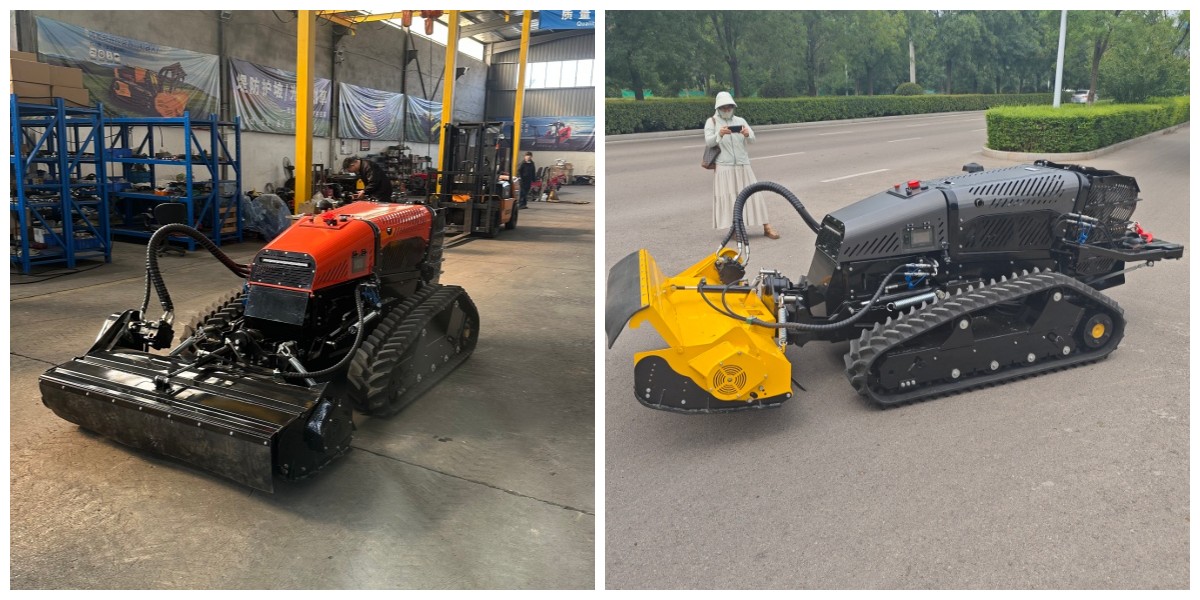
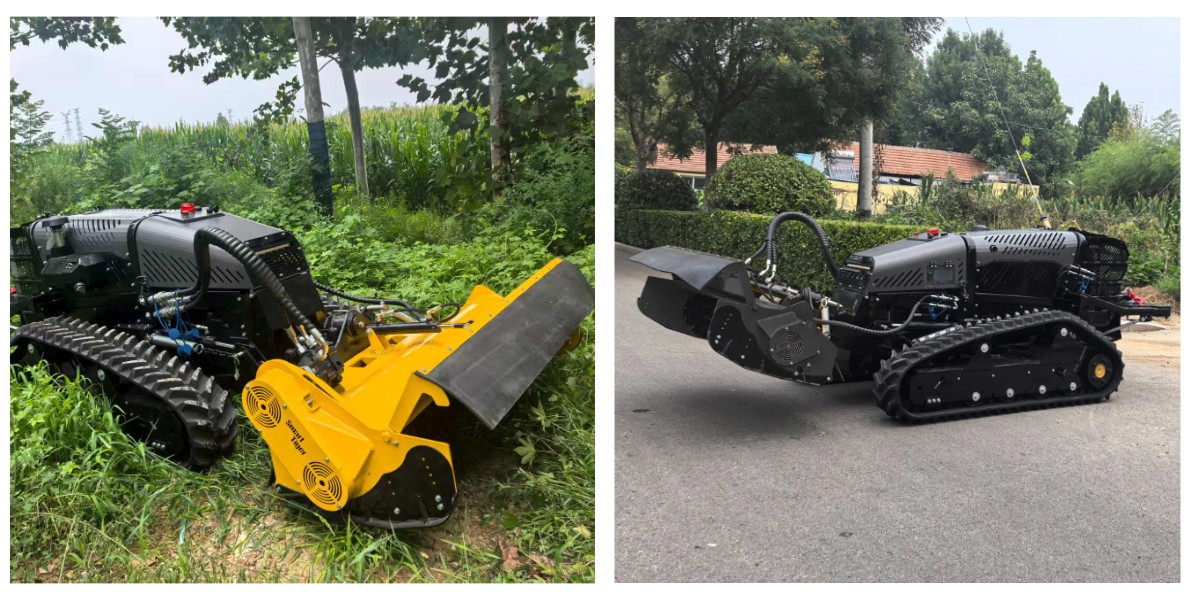
Huaying’s intelligent remote-controlled mowers are equipped with professional engineering-grade tracked chassis, which is specially optimized for complex and harsh terrain scenarios. The contact area between the rubber track and the ground is more than three times that of traditional wheeled equipment, providing super strong traction and anti-slip performance.
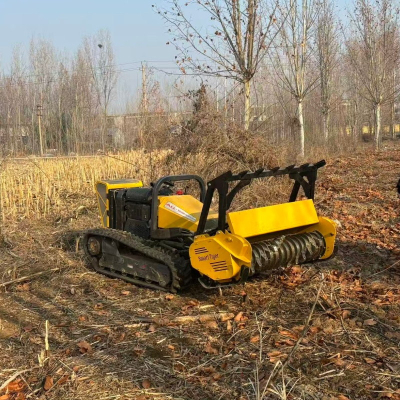
The professional tracked structure brings three core terrain adaptation advantages: First, ultra-strong slope adaptability. The HYZH-40PRO can stably operate on steep slopes up to 45°, far exceeding the 20° test limit of commercial zero-turn mowers, covering almost all slope greening scenarios in municipal, energy and water conservancy industries. Second, low ground pressure protection. The track evenly disperses the equipment’s weight, effectively avoiding soil compaction and rutting. It is very suitable for embankments, dams and water edge scenarios with high soil stability requirements. Third, excellent obstacle crossing ability. The tracked chassis can stably cross tree roots, stones and uneven ground barriers that block wheeled mowers, meeting the refined mowing needs of complex scenarios such as solar power stations.
Different from wheeled mowers that must turn around at the end of each mowing row (high-risk operation), Huaying’s tracked remote-controlled mowers support forward and reverse bidirectional mowing without turning, which not only ensures uniform mowing depth and consistent quality, but also completely eliminates the safety risks of slope turning operation.
Practical Application Scenarios of Intelligent Tracked Mowers
Relying on excellent terrain adaptability and safe remote control operation, Huaying remote-controlled tracked mowers are widely used in various harsh working scenarios that traditional equipment cannot handle efficiently:
Municipal road slope maintenance: It realizes safe and efficient greening trimming for highway embankments and road side slopes. The compact body design adapts to narrow operating spaces, keeping operators away from traffic risks and slope falling dangers.
Solar farm and energy base maintenance: The low-profile tracked structure can freely shuttle between solar panel arrays, adapt to undulating slope terrain, and complete vegetation trimming in narrow and complex spaces that traditional mowers cannot access.
Water conservancy embankment engineering: It is suitable for vegetation management of dams, levees and drainage ditches. The stable tracked performance adapts to humid and soft soil near water bodies, ensuring construction safety without damaging water conservancy infrastructure.
Power and pipeline corridors: It regularly trims overgrown vegetation in power line and pipeline protection zones, eliminating potential safety hazards caused by vegetation covering infrastructure. Remote control operation avoids personnel entering remote and rugged dangerous areas.
Part 4: Long-Term Operational Value — Higher ROI Beyond Initial Procurement Cost
Hidden Comprehensive Costs of Traditional Slope Mowing
Most procurement decision-makers only focus on the low upfront purchase price of traditional mowers, ignoring the huge hidden costs generated in the long-term operation process. The comprehensive operating cost gap is the key factor affecting enterprise profitability.
High labor cost consumption: Traditional slope mowing is labor-intensive and inefficient. As mentioned above, the labor input of a single project can be reduced from six workers to one, and the long-term cumulative labor cost saving is extremely considerable under the background of rising global labor prices.
High safety accident loss: Mowing safety accidents will not only cause irreversible personal injuries, but also bring huge economic losses such as worker compensation, project shutdown losses and enterprise reputation damage.
Re-work and quality loss: Uneven mowing quality caused by manual operation errors requires repeated trimming and manual remediation, prolonging the construction cycle and reducing project profit margins.
Accelerated equipment loss: Traditional mowers operating beyond the design terrain limit for a long time will accelerate the wear of engines, transmission systems and cutting decks, increase maintenance frequency and cost, and greatly shorten the service life of equipment.
Long-Term Value and ROI Advantages of Huaying Remote-Controlled Mowers
Huaying intelligent remote-controlled tracked mowers are not a simple replacement of traditional equipment, but a comprehensive upgrade of enterprise operation mode, bringing sustainable and high-value return benefits:
Labor resource optimization: One operator can independently complete the construction work that originally required a team of workers, effectively alleviating the industry’s labor shortage dilemma. Enterprises can expand business volume with existing manpower and undertake more engineering projects.
Expand high-value business channels: The equipment’s super terrain adaptability enables enterprises to bid for high-difficulty slope greening and complex vegetation management projects that competitors cannot complete, avoiding homogeneous low-price competition and creating exclusive high-margin niche business.
Improve team stability and recruitment competitiveness: Intelligent mechanical operation replaces traditional heavy manual labor, providing employees with a safer and more technical working environment. It helps enterprises attract professional technical talents and reduce team turnover rate.
Controllable full-life cycle operating costs: The equipment is designed for commercial heavy-duty scenarios, with a robust mechanical structure, convenient maintenance ports and low dependence on electronic accessories. It effectively reduces later maintenance costs and realizes predictable full-life cycle expenditure.
Excellent investment return rate: Compared with traditional commercial mowers, Huaying remote-controlled robotic mowers are tailored for extreme terrain, with lower labor input, fewer safety risks and longer service life. It significantly improves project productivity and customer satisfaction, bringing stable and high ROI for engineering contractors.
All Huaying equipment has passed CE certification to meet EU and international export standards, and supports ODM/OEM personalized customization. With professional industrial design and reliable quality, it provides targeted intelligent solutions for global professional vegetation management enterprises.
Conclusion: Choose Intelligent Equipment to Realize Sustainable Operational Upgrade
For engineering managers and procurement decision-makers engaged in complex terrain greening maintenance, the selection of mowing equipment is not only a technical choice, but also a core strategic decision related to enterprise safety operation and long-term development.
Traditional mowers have the advantages of low initial cost and simple operation, but they have unavoidable fatal defects: frequent safety hazards threatening personnel safety, low labor efficiency squeezing profits, terrain limitations restricting business expansion, and high hidden costs affecting long-term operation.
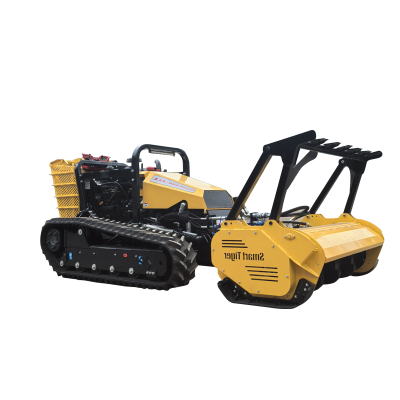
Huaying Intelligent Equipment’s remote-controlled tracked mowers create a new industry value system with safety-oriented design, standardized high efficiency, full-scenario terrain adaptability and high return on investment. Among them, the flagship HYZH-40PRO, with 45° ultra-steep slope operation capability, 200-meter long-distance remote control, hybrid power system and engineering-grade tracked chassis, has become the new benchmark for professional slope mowing equipment.
In the landscaping industry where safety, efficiency and profitability are core competitiveness, equipment upgrading has become an inevitable trend. Huaying’s intelligent remote-controlled mowers help global professional teams easily conquer complex steep slope scenarios, maintain high-standard construction quality, and build a safer, more efficient and more profitable sustainable operation system.
If you need detailed product parameters, real machine operation videos and personalized project solutions for roadside slopes, solar farms, drainage ditches, embankments and power corridor maintenance, please contact the Huaying Intelligent Equipment professional team at any time.