Remote Forestry Mulchers: The Transformative Technology Reshaping Global Wildfire Prevention
Remote Forestry Mulchers: The Transformative Technology Reshaping Global Wildfire Prevention
Global wildfire activity has undergone a drastic shift in recent years, marked by more frequent outbreaks, heightened intensity, and far-reaching destructive impacts. In the western regions of the United States, recurring large-scale, high-severity wildfire disasters have pushed local authorities to roll out extensive mechanical fuel mitigation programs, designed to curb the magnitude and severity of future fire events. This global trend is unambiguous: prolonged fire seasons, worsening arid conditions, and expanding human settlements in the wildland-urban interface have created an unprecedented demand for advanced, high-efficiency vegetation management solutions to mitigate wildfire risks.
Conventional wildfire prevention tactics, including prescribed burning, manual vegetation clearance, and standard heavy machinery operations, all suffer from inherent and restrictive drawbacks. Prescribed controlled burns carry inherent operational risks and are heavily constrained by fluctuating weather patterns, limiting their feasible implementation windows. Manual clearing work is notoriously time-consuming, labor-intensive, and poses severe safety hazards when conducted on steep, rugged terrain. Traditional bulldozers and excavators, the backbone of conventional mechanical treatment, struggle to maintain stable and safe operation on steep slopes, frequently cause irreversible soil damage, and fail to address high-risk vegetation zones in inaccessible terrain.
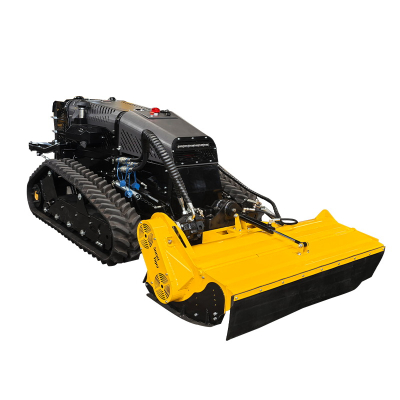
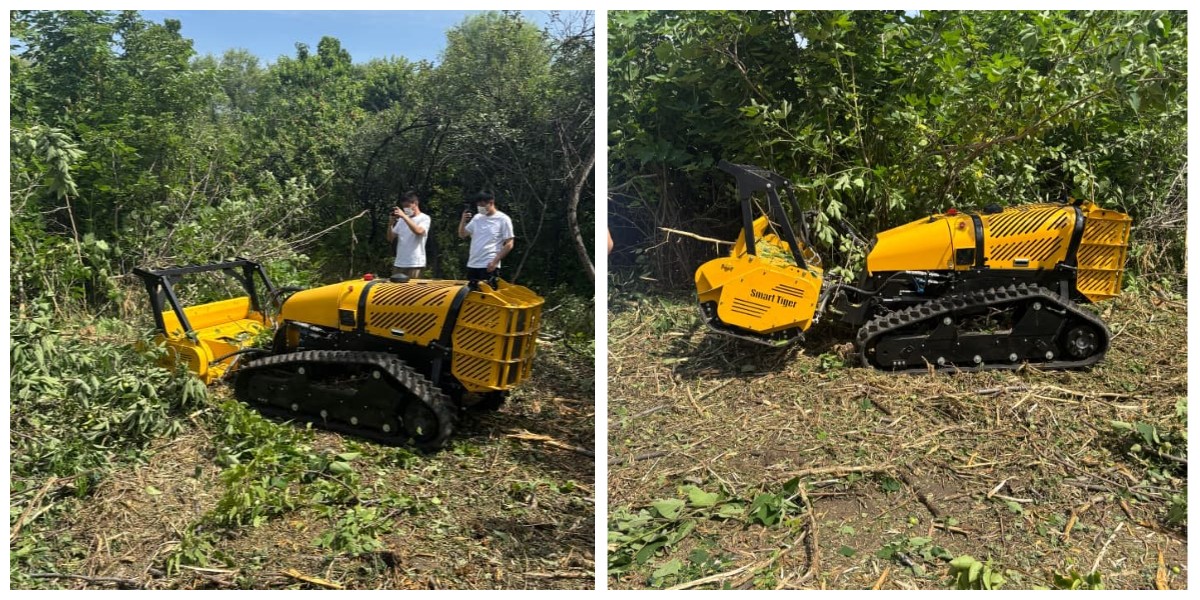
Against this backdrop, remote-controlled forestry mulchers have emerged as a groundbreaking technological breakthrough, completely overhauling the operational paradigm for wildfire risk mitigation and fuel load reduction among land administrators, fire service teams, and forestry professionals. Equipped with tracked chassis and wireless remote control systems, these specialized machines deliver safe and efficient vegetation treatment on the steepest and most treacherous landscapes. They convert flammable hazardous vegetation into protective organic mulch entirely off-site from human operators, eliminating on-the-job safety risks for field personnel.
This paper elaborates on the revolutionary role of remote forestry mulchers in modern wildfire prevention systems, analyzes the scientific principles of mechanical fuel load reduction, and explains why this innovative equipment has become an essential tool for mitigating catastrophic wildfire hazards worldwide.
Core Insights Into Wildfire Fuel Load Hazards
Definition and Risk Implications of Fuel Load
Fuel load refers to the total volume of combustible organic matter and accumulated vegetation within a specific forest or wildland area, covering dry grasses, fallen foliage, underbrush, shrubs, and young saplings. Excessively accumulated fuel loads create high-risk fire conditions, enabling wildfires to burn at higher temperatures, spread at faster speeds, and generate greater combustion intensity, which drastically increases the difficulty of fire containment and suppression.
Beyond fuel quantity, the structural arrangement of combustible materials is equally critical to wildfire behavior. Ladder fuels—low-lying vegetation and dead organic debris that form vertical combustion channels—represent a major wildfire threat. These fuels allow ground fires to climb rapidly into forest canopy layers, triggering uncontrollable crown fires that spread exponentially across forest landscapes. Forestry mulching technology specifically targets and eliminates ladder fuel structures, disrupting the vertical continuity of combustible vegetation and confining wildfires to ground-level burns that are far easier to manage and extinguish.
Verified data from the U.S. Forest Service confirms that mulching-based fuel treatments effectively reduce stand density and canopy bulk density while elevating the base height of forest canopies, which significantly minimizes the probability of severe active crown fires. In essence, targeted vegetation management via remote forestry mulchers does not merely clear excess vegetation—it fundamentally optimizes forest structure to alter and suppress destructive wildfire combustion patterns.
The Scale of Global Wildfire Mitigation Challenges
The economic and operational challenges of wildfire fuel mitigation are substantial. Mechanical fuel reduction projects incur highly variable costs, ranging from $40 to over $600 per acre, with final expenses determined by terrain complexity, vegetation density and type, and total treatment acreage. With millions of high-risk wildland acres concentrated in the western United States alone, the industry faces an urgent need for cost-effective, scalable, and high-efficiency fuel mitigation solutions.
Legacy mitigation methods are fundamentally unable to match the scale of current wildfire risks. Manual clearance operations are too slow and hazardous for large-scale deployment. While prescribed burning delivers reliable mitigation effects, its application is restricted by weather limitations, air quality regulations, and shortages of qualified professional personnel. Standard heavy machinery is incapable of accessing steep slope zones, which often constitute the most critical high-priority areas for fuel load reduction.
Remote forestry mulching technology fills this critical industry gap, providing a transformative solution to address the limitations of traditional wildfire prevention systems.
Remote Forestry Mulchers: Pioneering Terrain-Adaptive Fire Prevention Technology
Custom-Built Design for Extreme Rugged Terrain
Remote forestry mulchers are not standard mulching machines retrofitted with basic remote control functions. Instead, they are purpose-built, next-generation engineering solutions designed from the ground up for extreme terrain conditions and high-risk wildland operational environments.
This extreme terrain adaptability is the core competitive advantage of remote mulching technology, as the most urgent fuel reduction work is concentrated on steep, inaccessible slopes that are completely off-limits to conventional mechanical equipment.
Wireless Remote Operation: Safety-Centric Operational Innovation
The defining feature of remote forestry mulchers is their wireless remote control system, which eliminates on-site human operation—the primary safety hazard in steep-terrain vegetation management. By separating operators from working machinery, the technology removes personnel from all field operational risks.
Most mainstream models support long-distance wireless control, with operational ranges varying by model.
Field mitigation work often takes place near unstable slopes, under decaying dead trees with fall risks, or in isolated areas with limited emergency rescue access. Remote operation allows crews to complete essential fuel reduction tasks without exposing themselves to collapse, falling debris, or entrapment hazards.
Modern remote control systems feature industrial-grade reliability and comprehensive safety mechanisms, including one-touch emergency stop functions and rotor braking systems that instantly halt machine operation in response to sudden environmental changes. Equipped with large visual display panels and real-time diagnostic modules, these systems enable operators to continuously monitor machine operating status and terrain conditions for precise, safe control.
Scientific Mechanisms of Remote Mulching for Fuel Risk Reduction
Remote forestry mulchers are far more than simple vegetation clearance tools; they are precision scientific instruments for targeted forest fuel management. The specialized mulching process converts hazardous wildland vegetation into finely fragmented organic material, whose combustion properties differ drastically from untreated wildfire fuels.
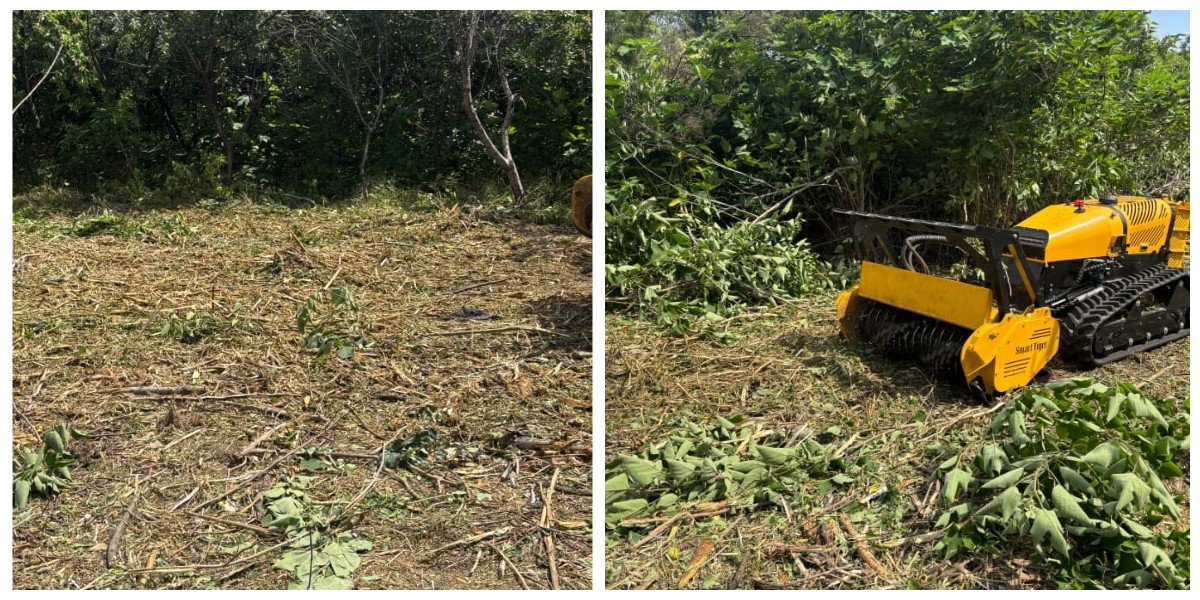
During operation, the equipment shreds dense underbrush, young saplings, and dead fallen vegetation into fine mulch fragments. This processed organic material decomposes gradually over time and exhibits far lower flammability compared to dry branches, logs, and raw wildland fuels, effectively reducing overall combustible fuel volume in treatment zones.
The benefits of mulching treatment extend beyond direct fuel removal. The layered mulch cover left on the ground delivers multiple ecological and fire-prevention functions: it shields topsoil from erosion, preserves soil moisture, and fundamentally suppresses wildfire ignition risks. Retained soil moisture reduces dry-field flammability, lowering the probability of spontaneous wildfire outbreaks.
Empirical research has fully validated the efficacy of this technology. Academic studies confirm that mulching treatment optimizes forest stand structure by reducing tree density and canopy bulk density while raising canopy base height, thereby mitigating crown fire risks. Classified as mechanical mastication treatment in forestry science, this technology modifies forest biomass structure by shredding vegetation into small fragments, breaking vertical and horizontal fuel connectivity to block wildfire spread pathways.
Most notably, field research data shows that trees in mulch-treated forest areas have a 300% higher survival rate during wildfire events compared to untreated forest zones. Multi-year combined mechanical and manual thinning treatments deliver the most prominent risk reduction effects, with single mechanical mastication ranking as the second-most effective fuel mitigation strategy.
Core Practical Applications in Wildfire Prevention Systems
Wildland-Urban Interface Defensible Space Construction
Creating safe defensible space for residential and community zones in the wildland-urban interface is one of the most vital applications of remote forestry mulchers. By reducing excessive fuel loads in high-risk fringe areas between urban settlements and wildlands, the equipment builds effective fire buffer zones to protect residential communities, public infrastructure, and ecological resources.
This application is particularly critical for high-fire-risk U.S. states including California, Colorado, and Oregon, which suffer from frequent, destructive wildfire disasters. Field teams utilize remote mulchers to rapidly clear dense underbrush and small trees along roadside corridors, ridgelines, and other strategic locations. The processed mulch inhibits rapid vegetation regrowth, stabilizes soil conditions, and forms a persistent fire-resistant buffer layer.
Oregon’s Applegate Valley Fire Equipment Acquisition project serves as a typical real-world application case. The project introduced two tracked remote-controlled forestry mulchers to upgrade vegetation removal efficiency in high-risk zones near key public infrastructure. The core project objectives include optimizing fuel reduction around critical facilities, ensuring unobstructed emergency evacuation routes, eliminating hazardous overgrown vegetation, and preventing catastrophic wildfires that threaten local residents’ lives, property, and regional economic stability.
Strategic Wildfire Firebreak Development
Firebreaks—vegetation-free buffer strips designed to block and slow wildfire propagation—are a core component of modern wildfire suppression systems. Precision forestry mulching enables the construction of standardized, high-efficiency firebreaks to contain fire spread ranges.
Remote forestry mulchers are uniquely suited for firebreak construction in complex terrain where traditional manual and mechanical methods are unfeasible.
Critical Infrastructure Fire Risk Protection
Power transmission lines, pipeline networks, and other key public infrastructure are extremely vulnerable to wildfire damage. Uncontrolled vegetation overgrowth can block maintenance access, damage mechanical equipment, and form severe fire hazards. Remote forestry mulchers provide a fast, low-impact solution for long-term infrastructure corridor maintenance and fire risk control.
By integrating remote mulching technology into routine infrastructure maintenance plans, management departments not only comply with industrial safety regulations but also enhance the disaster resilience of key facilities during wildfire seasons.
Forest Ecological Health Restoration
Beyond immediate wildfire risk mitigation, remote forestry mulching supports long-term forest ecosystem health and sustainable development. Overgrown underbrush and invasive plant species compete with native trees for sunlight, soil nutrients, and water resources, leading to forest stress, increased disease and pest infestation risks, and heightened wildfire susceptibility.
Targeted mulching treatment relieves forest overcrowding, restores ecological balance, and promotes healthy native vegetation growth. Robust, well-structured forests possess stronger natural fire resistance and are less prone to large-scale catastrophic fire losses. The decomposed mulch residue replenishes soil nutrients, fostering the growth of fire-tolerant native plant communities and forming a virtuous ecological cycle.
The Tahoe Keys forest restoration project, recognized as a transformative local ecological initiative, fully demonstrates this integrated management model. In collaboration with the U.S. Forest Service, the project completed mechanical mastication treatment across 43 acres of forest land using remote-controlled mulching equipment. The treatment eliminated vertical ladder fuel structures that enable canopy fires, simultaneously improving forest ecological health and reducing long-term wildfire hazards.
Economic and Operational Advantages of Remote Mulching Technology
Large-Scale Cost Efficiency
Wildfire prevention projects face universal budget constraints, requiring every investment to deliver maximum risk-reward value. Remote forestry mulchers deliver outstanding economic advantages compared to conventional mitigation methods.
First, the equipment delivers vastly higher operational efficiency than manual clearing. A single operator managing a remote mulcher can complete workloads that previously required an entire field crew, effectively alleviating the industry’s persistent labor shortage challenges.
Second, mulching treatment delivers long-lasting results and reduces repeated operational costs. Traditional mowing and clearance methods require frequent re-treatment due to rapid vegetation regrowth. In contrast, the mulch layer left by remote mulching suppresses vegetation regrowth, extending treatment validity and cutting long-term maintenance frequency and costs.
Third, the technology’s ecological advantages translate to economic savings. It eliminates the need for chemical herbicide application and repeated mechanical trimming, enabling sustainable low-cost forest management and reducing long-term ecological governance expenditures.
Optimized Emergency Response Access
A frequently overlooked yet critical benefit of remote mulching fuel reduction is the improved accessibility of wildland areas for emergency response teams. Overgrown vegetation often blocks fire rescue vehicle passages and restricts crew movement during wildfire emergencies. By thinning dense vegetation and clearing trail and road corridors, mulching treatment accelerates emergency response speeds, creating a critical time advantage for fire suppression and property rescue.
Insurance Risk Management Optimization
Proactive fuel reduction via remote mulching provides a credible solution for risk mitigation. Documented professional vegetation management treatment enables communities and property owners to demonstrate reduced fire risk profiles to insurance providers. As verified in the Tahoe Keys project, standardized mulching treatment data supports accurate wildfire risk modeling, helping mitigate rising insurance premium pressures in high-risk regions.
Standardized Operational Best Practices
Pre-Operation Site Assessment and Strategic Planning
Prior to deploying remote forestry mulchers, operators must conduct comprehensive on-site surveys to map terrain features, identify steep slope zones, locate obstacles and potential hazards, and formulate targeted operational plans. Detailed analysis of soil properties, vegetation density, moisture levels, and slope angles allows operators to adjust equipment parameters and select suitable attachments for optimal treatment results. Most modern units are equipped with real-time incline monitoring displays to ensure operations stay within safe slope limits.
Scientific Equipment Selection and Parameter Configuration
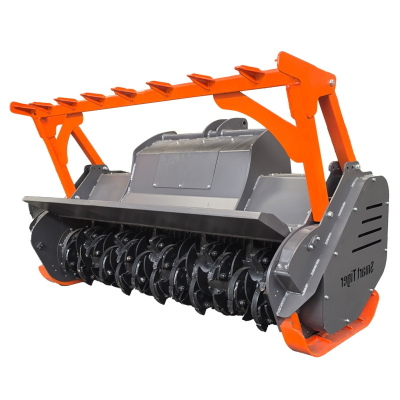
Terrain and vegetation conditions determine the optimal equipment configuration, which directly impacts operational productivity, fuel consumption, and environmental protection effects. Matching mulching head types to treatment scenarios is particularly critical. Fixed-blade or carbide hammer mulching heads are ideal for dense brush and small-diameter trees, while swinging hammer attachments deliver higher efficiency for light vegetation and shrub clearance.
Standardized Safety Protocols and Routine Maintenance
Though remote operation separates personnel from high-risk field environments, standardized safety management remains indispensable. Operators must maintain real-time communication with ground support teams, continuously monitor machine operating status, and activate emergency stop functions immediately in the event of abnormal conditions.
Synergistic Integration With Diversified Mitigation Strategies
Remote forestry mulchers achieve maximum risk-reduction efficacy when integrated with other professional fuel mitigation techniques. Mechanical mulching can be implemented as an independent treatment or used for pre-treatment fuel reduction to create safer conditions for subsequent prescribed burning. In dry coniferous forest regions, mechanical thinning is commonly adopted to reduce stand density and eliminate ladder and canopy fuels, laying a foundation for precise surface fuel management via prescribed burns.
Future Development Trends of Wildfire Prevention Technology
Remote forestry mulching represents a pivotal innovation in wildfire prevention technology and marks a key shift toward automated, unmanned operation in modern forest resource management. Ongoing technological iteration will drive further upgrades in mulcher performance and functionality.
Future industry innovations will focus on enhanced autonomous operation capabilities, intelligent obstacle detection and avoidance systems, and expanded extreme terrain adaptability. Integration with drone aerial surveying and high-precision mapping technology will enable data-driven, refined fuel reduction planning, further improving operational accuracy and efficiency. Growing environmental sustainability demands will also promote technological optimization, with upgraded equipment designs further reducing soil compaction, eliminating chemical auxiliary materials, and enhancing soil nutrient restoration effects.
The escalating global wildfire crisis is accelerating the large-scale adoption of remote mulching technology. As Wade Crowfoot, Secretary of the California Natural Resources Agency, commented on the Tahoe Keys project, such innovative management initiatives are game-changing and require widespread promotion. The U.S. Forest Service and other public environmental agencies will continue to expand cooperative projects to scale up mechanical fuel reduction operations.
Conclusion: Proactive Prevention as the Core of Modern Wildfire Governance
Global wildfire disasters are growing more frequent, destructive, and costly each year. While traditional wildfire prevention methods retain partial practical value, they are no longer capable of addressing the large-scale, high-intensity wildfire risks facing modern society. Innovative tools and upgraded management strategies have become essential for wildfire risk governance.
Remote forestry mulchers provide a comprehensive transformative solution for wildfire prevention. Integrating wireless remote control, stable tracked chassis, and high-performance mulching attachments, the technology enables safe, efficient, and precise vegetation treatment on the most rugged and inaccessible terrains. It eliminates hierarchical fuel structures, reduces overall forest fuel loads, and constructs strategic firebreak systems, all while completely protecting field personnel from operational dangers.
Beyond direct fire prevention effects, remote mulching technology boosts forest ecological health, improves emergency rescue accessibility, and delivers cost-effective large-scale fuel mitigation solutions. It has become an indispensable core tool for fire departments, land management agencies, infrastructure operators, and private forest landowners in combating catastrophic wildfires.
The technological maturity of remote forestry mulching is fully established. The current industry focus has shifted from verifying technological validity to accelerating large-scale operational integration. As Tom Harbour, former National Director of Fire and Aviation Management for the U.S. Forest Service, emphasized: “The best way to fight wildfires is to prevent them. Vegetation management is our first line of defense.” Remote forestry mulchers are strengthening this critical line of defense, making modern wildfire prevention work safer, more efficient, and more reliable than ever before.