Where Full-Size Pavers Can't Go, the Small Asphalt Paver Takes Over
The Small Asphalt Paver: Why Narrow-Path Paving Is the Fastest-Growing Equipment Segment in 2026
Every paving season begins with the same constraint: more work than crews to do it. Utilities open trenches in residential streets, municipalities rebuild sidewalk panels one block at a time, and facility owners need forecourts and driveways resurfaced before winter. Almost none of that work suits a three-metre screed. The small asphalt paver exists for precisely this gap, and over the past three seasons it has moved from a niche accessory to a first-line purchase for maintenance contractors, rental fleets and public works departments.
A Market Growing Where Full-Size Machines Cannot Go
Independent market research places the global compact paver segment at USD 485.6 million in 2025, rising to USD 688.4 million by 2032, a compound growth rate of roughly 5.1%. The wider commercial paver market expands at about 5.2% from a far larger base of USD 1.58 billion. Neither figure is spectacular, but the compact end is unusually durable: it tracks maintenance cycles rather than individual capital projects, and it holds up when new-build budgets are cut. A small asphalt paver is bought to keep revenue flowing through the twelve months of the year when large machinery sits idle.
PW ConsultingMarket Research Intellect
Where the volume actually comes from
Three buyer groups drive this segment. Municipal and county public-works departments, which must keep footways accessible and defensible against trip-and-fall claims — one US county alone maintains 5,400 miles of road and 1,700 miles of sidewalk, and justifies its programme on the principle that every dollar spent on maintenance avoids six to ten dollars in later reconstruction. Utility and telecom contractors reinstating 300–600 mm trenches, where the paved strip is only a fraction of the excavation. And rental fleets, which place a walk-behind asphalt paver with landscapers and small builders who could never justify a four-tonne machine.
mocofeed.com
Why Contractors Are Buying Walk-Behind Asphalt Pavers Now
Labour, not capital, is the binding constraint
The most-cited statistic in the industry explains the shift. Surveys by the US National Asphalt Pavement Association found that 63% of paving contractors turned down work in 2025 because they lacked crew capacity, while 25–30% of experienced operators are within ten years of retirement. A fully loaded operator now costs USD 58,000–68,000 a year. Where a crew of eight to ten men with rakes and lutes once handled edge work and patching, one operator on a narrow-path asphalt paver now delivers comparable output — the figure quoted by manufacturers of this class of machine is one unit replacing 8–10 manual workers.
Stealth Agents
Site access changed before equipment did
Gate widths, shared-use paths, planted medians, buried services and protected street furniture have all narrowed the working corridor. A unit that fits through a 1.2 m opening, turns on a swivel caster and loads onto a pickup is now the difference between winning a maintenance package and declining it.
What Separates a Working Small Asphalt Paver from a Toy
Width range and depth control
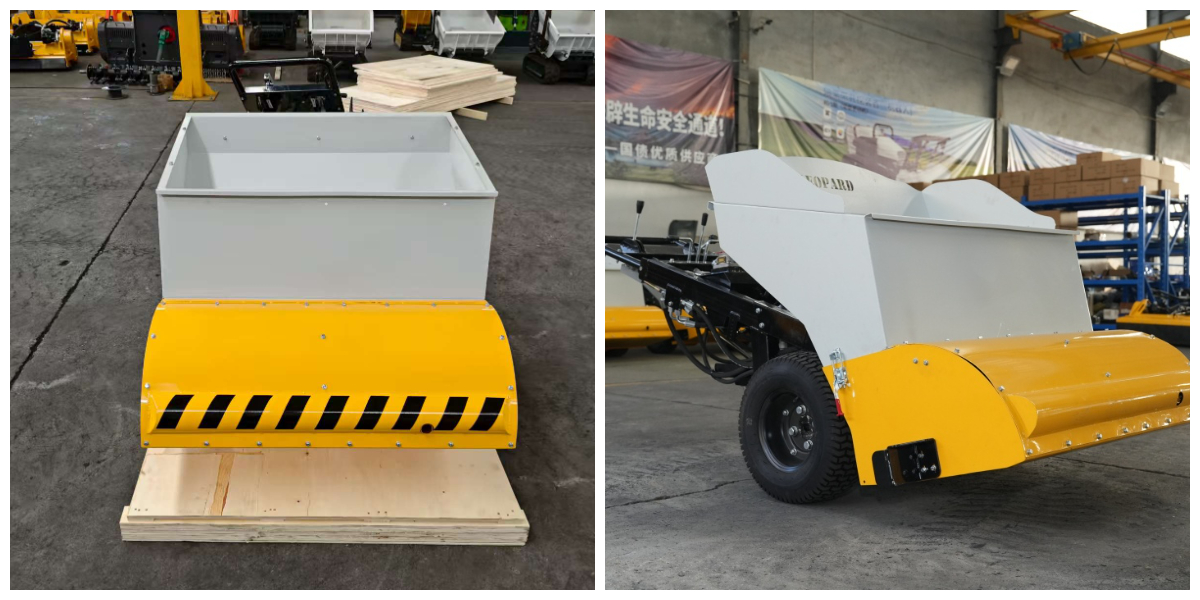
A serious small asphalt paver offers four selectable paving widths between 250 mm and 1000 mm, not one fixed screed. The range matters commercially: 250–300 mm covers footway edges, trench capping and kerb returns; 500–750 mm suits cycle tracks and forecourts; 1000 mm takes a full residential lane in two passes. Depth should be adjustable independently on each side from 20 to 100 mm, with hydraulic locks so the screed does not creep once load comes on — the difference between a mat that holds cross-fall and one that has to be corrected by hand.
Screed heat decides mat quality
This is the detail buyers under-specify and later regret. A cold screed drags, tears the surface and leaves a finish that must be raked and rolled twice. Exhaust-heated screeds keep the plate at working temperature continuously, using heat the engine produces anyway, so a twenty-metre run still pulls away flat and tight. On patch work, where runs are short and frequent, this single feature decides whether the result looks professional.
Drive and control layout
Hydrostatic drive gives stepless speed with forward and reverse on a single handle, so the operator backs onto the joint without walking round the machine. Two hydraulic drive wheels plus a swivel caster hold a straight line on camber. Four high-pressure ball valves control four discharge ports independently, matching feed to the width actually being laid, and a removable 150 L hopper takes mix from a tipper or wheelbarrow and cleans out at end of shift.
From Steel Plate to Finished Machine
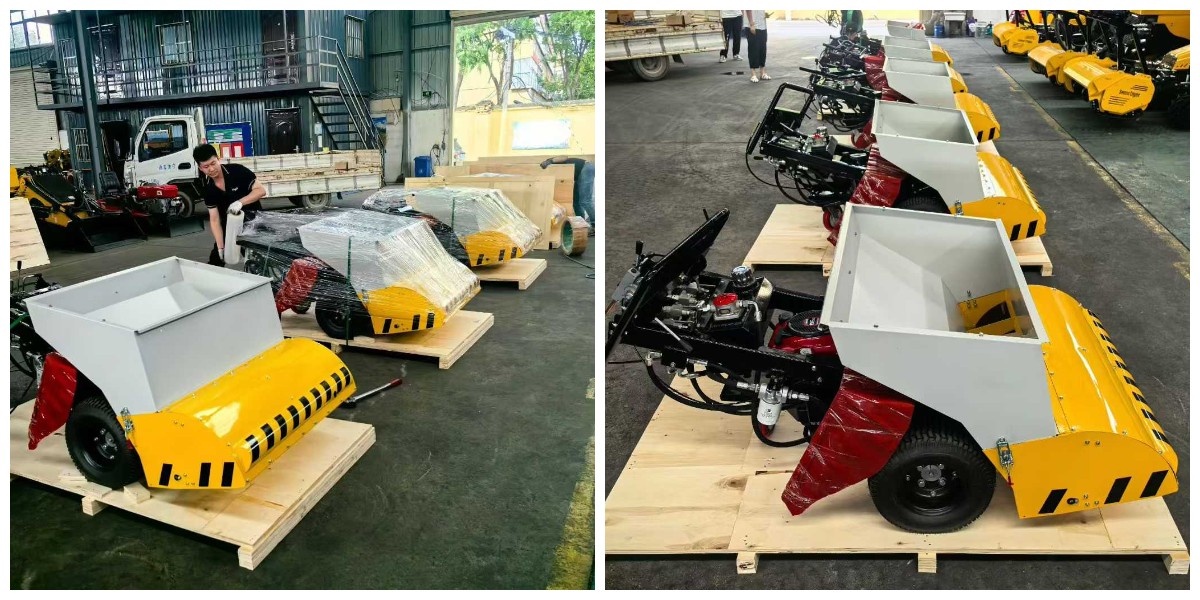
Production of a small asphalt paver follows a short but uncompromising sequence. Chassis and hopper plates are laser-cut and jig-welded, then shot-blasted and primed before powder coating, because the machine lives in abrasives and hot bitumen. Hydraulic assemblies are built and pressure-tested as sub-assemblies, and each hydrostatic circuit is bench-run at rated flow before it reaches the frame. The engine is mounted and emission-verified to the standard of the destination market — Stage V in Europe, EPA in North America — and the two certificates are not interchangeable, so buyers should state the market at order stage rather than assume. Screed plates are checked for flatness, and every unit completes a loaded paving trial before crating at 1690 × 1000 × 1150 mm.
Applying a Narrow-Path Asphalt Paver on Site
Saw-cut and remove the failed material, clean and tack the surface, then set width and depth before the first load is tipped. Hot mix goes into the 150 L hopper; the machine lays at up to 28 m/min and repositions at 3.2 km/h, so one unit can cover three patches on the same street before lunch. Joints are where quality is won or lost: overlap the previous mat by the heated edge of the screed, keep pass speed constant, and compact behind with a plate or light roller while the mat is still above 110 °C.
Procurement Trends Shaping 2026
Three patterns are visible in enquiries this year. Right-sizing — buyers want the smallest machine that completes the job, because transport and site-access cost now outweigh the capital saved by going larger. Emission as a tender criterion — municipal contracts increasingly demand declared Stage V compliance, and suppliers without the certificate are excluded at pre-qualification. Total cost of ownership — purchase price is now compared against saved labour hours, screed plate life, and the revenue from maintenance packages that would otherwise be declined.
FAQ
How narrow can a small asphalt paver work?Down to 250 mm. Four widths — 250, 500, 750 and 1000 mm — cover most footway, trench and forecourt work without a second screed.
Can a walk-behind asphalt paver lay a full traffic lane?Not efficiently. The format is engineered for widths up to 1 m; beyond that, passes multiply and joint quality suffers. It complements a full-size paver rather than replacing one.
What engine and emission standard does it use?A petrol single-cylinder of about 3.2 kW with a 4 L tank — strong torque at low fuel consumption. Certificates differ by market: Stage V for the EU, EPA for North America. Specify the destination market when ordering.
How is it transported, and how many people does it need?About 260 kg empty, 530 kg maximum operating weight, 1690 × 1000 × 1150 mm transport size — a pickup or small trailer and one operator, no crane required.
Request a Specification Pack
If your 2026 programme includes footway rebuilding, trench reinstatement or forecourt resurfacing, the question is no longer whether a small asphalt paver pays for itself, but which width configuration and emission certificate your contracts require. Send us the paving width you work at most often and the job type, and we will return the full specification sheet, a working video of that exact configuration, FOB pricing and the emission certificate for your market.