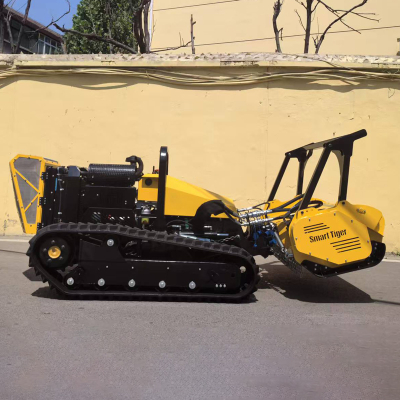
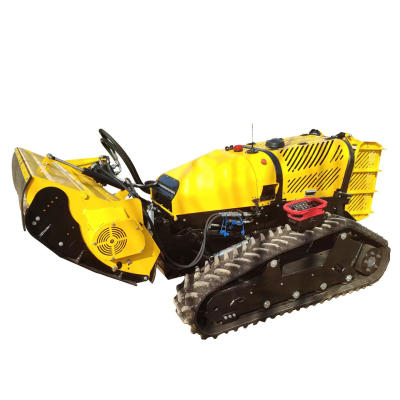
Remote Controlled Slope Mower Field Test: Rocky Roadside Weed Clearing
Remote Controlled Slope Mower On-Site Trial: Reliable Rocky Roadside Weed Clearing on Steep Inclines
Industry Background & Market Trend for Roadside Slope Vegetation Management
Municipal road departments, infrastructure contractors and vegetation service providers face persistent operational pain points on rocky roadside slopes. Roadside embankments are scattered with loose stones, rugged outcrops and uneven subsurface, while overgrown weeds and brush accelerate soil erosion, block drainage channels and raise wildfire risks along transport corridors. Traditional ride-on mowers easily lose traction, tip over or suffer blade damage when hitting rocks; handheld brush cutters force workers to stand on unstable slopes, exposing crews to slip and fall hazards, and the overall clearing speed is far below commercial project requirements.
Against this backdrop, the global remote controlled slope mower market maintains steady expansion. According to PW Consulting market data, the worldwide remote control slope mower market reached USD 248.43 million in 2025 and is projected to hit USD 439.76 million by 2032, recording a compound annual growth rate of 8.5%. Europe remains the largest regional market, driven by strict workplace safety regulations and EU Stage V emission standards; North America and Oceania also see rising procurement demand from highway maintenance teams, utility corridor operators and forestry contractors. The core industry trend is clear: buyers are shifting from low-cost manual tools toward tracked remote slope mowers with rock-resistant cutting assemblies, prioritizing operator safety, continuous working capacity and adaptability to stony, rough slope terrain.
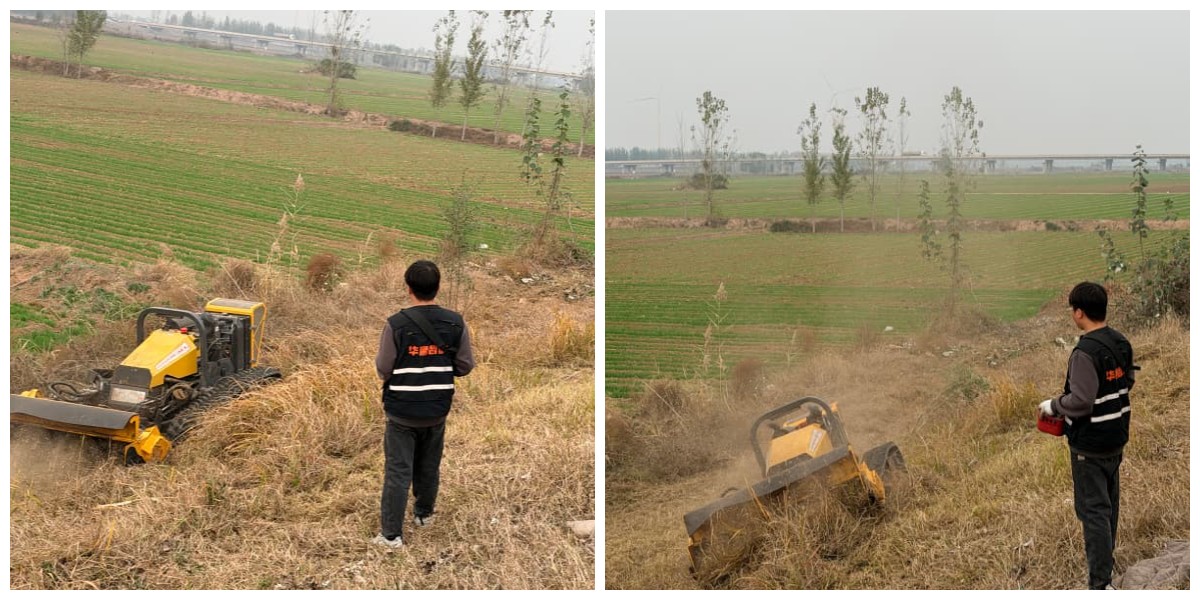
On-Site Field Test: Remote Slope Mower Clears Weeds on Rocky Slope Road
Our technical team travelled to the client’s project site for a full functional trial on a rocky roadside slope, a typical tough working condition full of scattered gravel and protruding stones. The primary test objective was to verify whether our remote controlled slope mower can sustain stable movement and consistent weed cutting performance without frequent blade breakage or chassis jamming when rolling over exposed rock debris.
Test Site Condition Overview
The test section belongs to a hillside access road, with gradient ranging from 32° to 48°. The slope surface is covered with mixed weeds, tough brambles and scattered sharp stones of varying sizes. Many conventional mowers cannot work here: wheeled models slip on loose gravel, while ordinary cutting decks sustain severe impact damage once striking rocks. The client’s original clearing scheme relied on manual cutting, which took three workers multiple days to finish the same stretch and carried high fall risk.
Field Test Execution & Observation
Before startup, technicians completed standard pre-operation inspection: track tension adjustment, cutting height calibration, emergency stop function verification and remote signal range testing. The operator stood at a safe zone away from the slope edge and guided the tracked remote slope mower forward along the contour line.
During the whole test, the low-center-gravity tracked chassis delivered steady traction over uneven, stony ground. When the cutting deck made contact with scattered stones, the rock-tolerant floating cutter structure buffered instantaneous impact effectively. The machine continued shredding thick weeds and grass clumps smoothly, without stalling, track slippage or catastrophic blade failure. The remote controlled slope mower navigated small rock protrusions, gravel depressions and undulating slope surfaces continuously, finishing weed clearing with uniform cutting results. The client’s on-site supervisors confirmed that the machine handled rocky obstacles far better than other slope mowers they had previously rented.
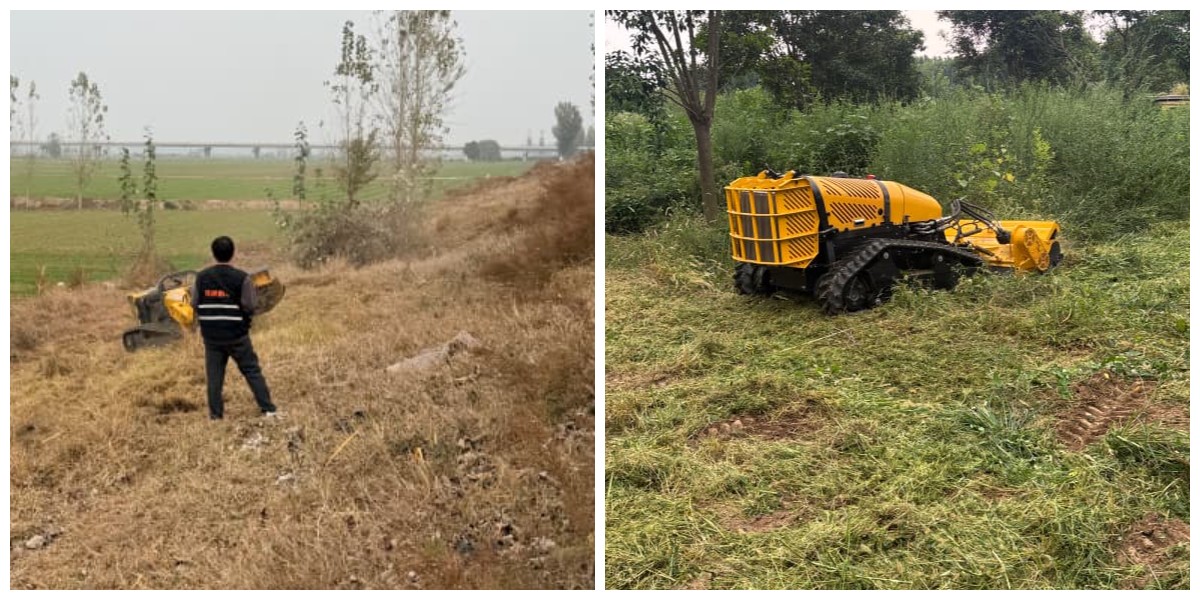
Core Technical Design That Supports Rock-Resistant Slope Clearing
The stable performance witnessed in this roadside trial originates from targeted mechanical design, not simple structural reinforcement. Every component is engineered for hazardous, stony slope vegetation clearing.
First, the heavy-duty tracked undercarriage with wide rubber tracks disperses ground pressure, improving grip on loose rocky soil and preventing skidding on inclined surfaces. The low gravity layout further enhances rollover resistance when crossing stone ridges. Second, the floating cutting deck and tungsten-alloy cutting blades absorb impact when hitting rocks. Unlike rigid fixed decks, the floating structure automatically lifts slightly upon hard contact, reducing direct impact force transferred to blades and gearboxes and extending service life in stone-rich terrain. Third, the 2.4G long-range wireless remote control keeps operators away from unstable slope edges, avoiding fall and flying debris injury risks. Dual safety interlock and automatic shutdown systems trigger protection if the machine exceeds its safe tilt angle.
Beyond rocky roadside weed clearing, this remote controlled slope mower supports quick attachment swapping, transforming into a mulcher for brush shredding, a snow removal unit or a maintenance carrier for other slope projects. Our production process applies standardized welding, CNC machining and strict load testing before delivery; every unit runs terrain simulation testing to verify stability and impact resistance before shipment, so commercial buyers receive field-ready equipment instead of untested prototypes.
FAQ for Commercial Buyers of Remote Controlled Slope Mower
Q1: Can this remote slope mower keep working reliably on slopes covered with loose stones?
A1: Yes. The floating cutting deck and tungsten blades are designed to tolerate occasional rock impacts. It is built for rocky roadside embankments, hillside access roads and stony utility corridors. It cannot sustain repeated heavy collisions with large boulders, and we recommend site survey and route planning before large-scale clearing jobs.
Q2: What is the maximum working slope of this remote controlled slope mower?
A2: The machine is rated for slopes up to 55 degrees. Actual safe working gradient depends on ground condition, moisture and rock coverage. On wet, gravel-rich slopes, we advise reducing the working angle properly for extra stability.
Q3: Is spare cutting blade easy to source after purchase?
A3: We supply original wear parts including tungsten blades, track blocks and hydraulic seals. Spare parts can be shipped together with your main unit or delivered separately for after-sales maintenance, supporting long-term fleet operation for contractors and municipal teams.
Q4: Can we customize machine color and branding for our fleet?
A4: Yes. We support OEM customization, including custom paint color even for a single unit, logo marking and attachment package adjustment, to match your company fleet requirements.
Conclusion & Call to Action
This rocky roadside slope field test proves that our remote controlled slope mower solves a long-standing pain for commercial vegetation management contractors: safe, continuous weed clearing on stone-strewn steep roadside embankments. It cuts labour risk, speeds up roadside maintenance cycles and lowers downtime caused by rock impact damage to traditional mowers.
If your team takes charge of highway embankment maintenance, utility corridor clearing, hillside firebreak construction or rocky slope vegetation control, contact our engineering team today. We can share full test footage, detailed technical datasheets and customized quotation for your site conditions. Our team also arranges remote operation guidance and after-sales technical support to help you deploy this remote slope mower on your hazardous slope projects quickly.